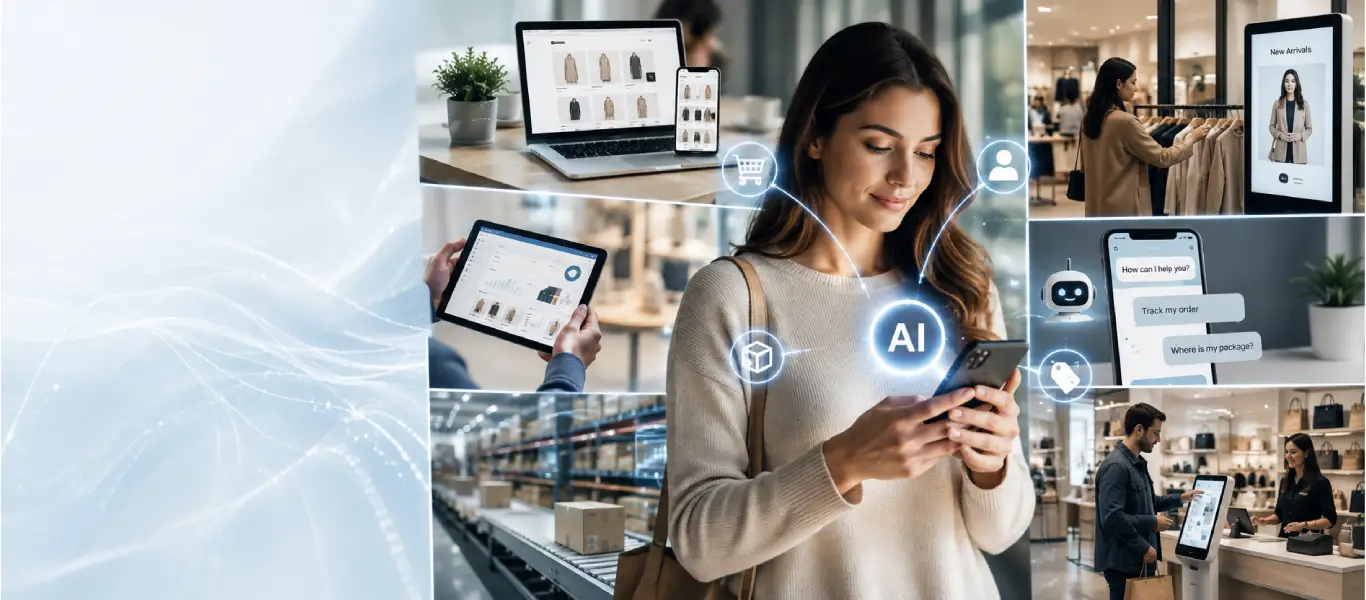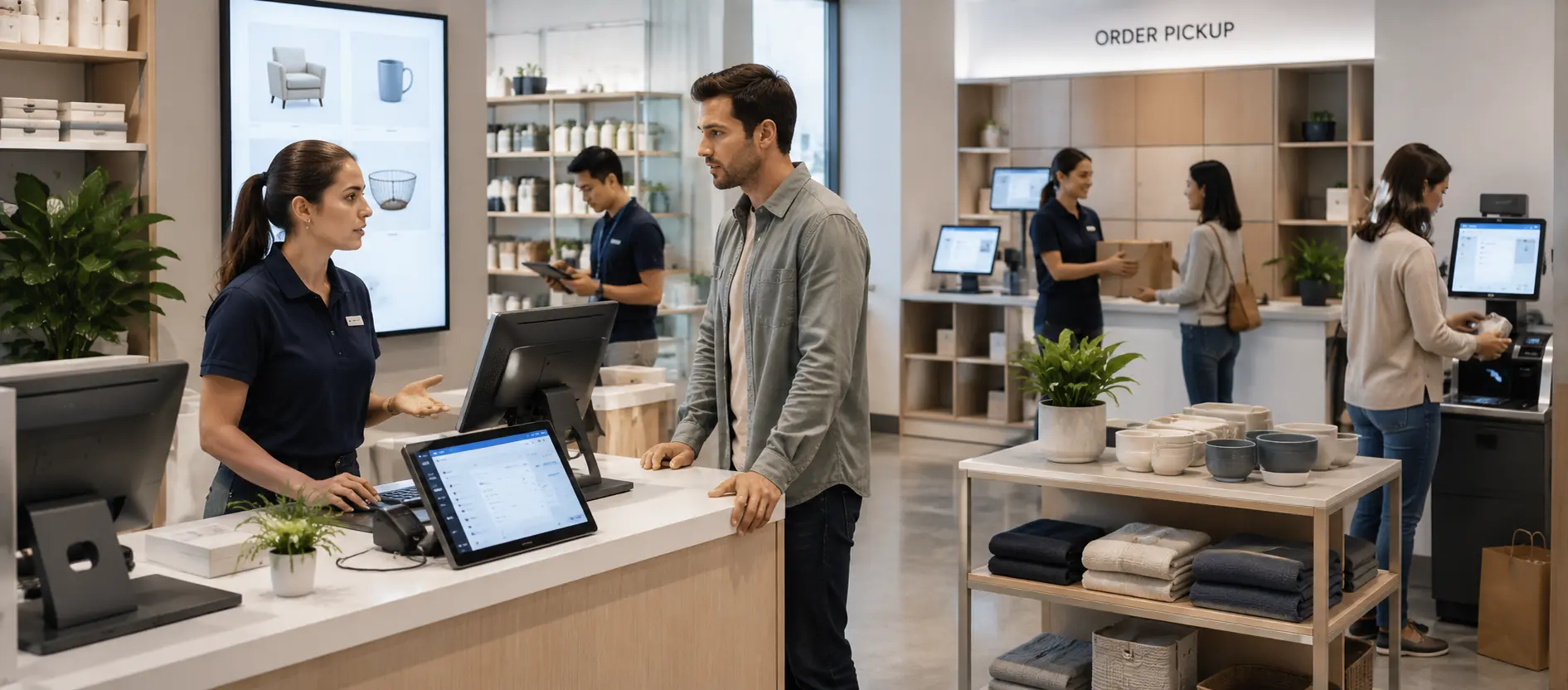



Customers no longer think in terms of online or offline shopping. They expect connected journeys across every interaction with a retailer, whether they check product availability online before visiting a store, rely on an associate to complete a purchase using customer preferences and inventory data, or buy online and pick up or return items in-store. A successful omnichannel retail strategy requires more than adding new digital channels or refreshing a website. Retailers need connected systems that unify customer data, inventory, physical stores, and digital experiences into a single operational framework. SkillNet Solutions helps retailers enable connected commerce experiences by integrating store technologies, POS systems, and digital channels.
This expectation is already mainstream: Salesforce reports that 74% of customers expect to be able to do anything online that they can do in person or by phone, reinforcing the need for retail systems that support a consistent journey across channels.
Why Most Omnichannel Strategies Break at the Systems Layer, Not the Strategy Layer
Retailers already know the theory behind modern commerce—journey mapping, unified customer data, and real-time inventory visibility are well-established concepts. The failure point rarely lives in the strategy deck. It lives at the systems layer: legacy point-of-sale platforms, disconnected inventory systems, and fragmented CRM or loyalty data that cannot synchronize in real time. Closing the execution gap requires addressing these architectural bottlenecks directly rather than layering more strategy on top of broken data pipelines.
Real-Time Inventory Visibility: The Foundation Everything Else Depends On
Unified stock visibility across the store, warehouse, and online channels goes far beyond displaying a basic “check local availability” note on a product page. True omnichannel enablement relies on accurate, location-aware data, supported by effective store inventory management, feeding every downstream customer touchpoint.
Accurate inventory is foundational to buy online, pick up in store (BOPIS), ship-from-store, and same-day delivery. When this data layer is delayed or wrong, omnichannel initiatives can quickly run into operational friction. Common real-world failure points include overselling popular items during flash sales, showing online stock that has already sold out on the physical sales floor, and suffering from phantom inventory across regional distribution nodes. Maintaining accurate visibility across these nodes helps reduce fulfillment errors, avoid orders being routed to unavailable stock, and improve the reliability of customer pickup and shipping promises.
Flexible Fulfillment: Making BOPIS and Ship-from-Store Work at Scale
Order management and orchestration engines must connect incoming customer orders to the nearest available inventory source, whether that inventory sits in a local store, a regional distribution center, or a dedicated fulfillment hub. Robust omnichannel solutions for retailers turn physical storefronts into active fulfillment nodes rather than transaction points alone.
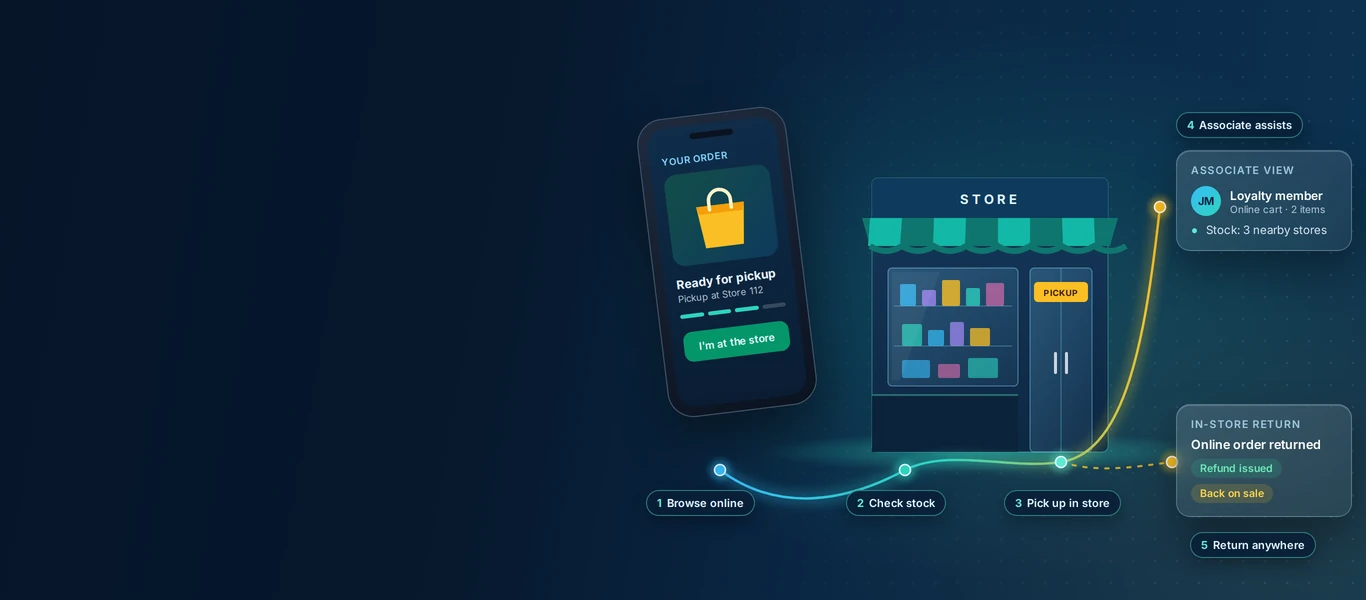
When an order is placed online, intelligent orchestration rules evaluate inventory thresholds across the network. A BOPIS order routes the request to the local store with confirmed on-hand stock and alerts the associate to pick the item. If the local store is out of stock, fulfillment defaults to a regional distribution center or a nearby store enabled for ship-from-store. The endless aisle extends the same logic to the sales floor, letting an associate sell an item the store does not stock and ship it from wherever it sits.
Returns are another common point of friction. When a customer returns an online order in-store, the store system should be able to retrieve the original transaction, apply the retailer’s return and refund rules, and update inventory status appropriately. If the item is eligible for resale, timely inventory updates help make that stock available to other channels.
Equipping Store Associates to Close the Digital-Physical Gap
The store associate experience represents the most frequently overlooked link in the connected customer journey. Mobile POS and clienteling tools give them direct visibility into a shopper’s online purchase history, saved carts, and personal preferences right at the point of interaction.
Real-time inventory across the enterprise network turns that visibility into a sale. An associate who can see stock at three nearby stores and the distribution center executes a “sell from anywhere” model without leaving the floor to check a backroom. The operational requirement is a single interface. The moment an associate switches between a POS terminal, a separate inventory lookup, and a CRM screen, the interaction stalls and the connected journey collapses at the last step. Modern omnichannel retail solutions can bring customer, inventory, and order information into a more connected associate experience.
Unifying Customer Data Without Creating Another Silo
Connecting loyalty programs, CRM records, and transaction data across platforms such as Oracle Retail Customer Engagement and digital commerce systems ensures that customer profiles, active carts, and preferences follow the shopper smoothly across devices and channels. Customer journey mapping and retail analytics serve as the operational layer that turns raw unified data into usable personalization rather than just filling a passive warehouse. The trap to avoid is unifying data technically but never operationalizing it through associate-facing tools or personalized digital engagement use cases.
How SkillNet Approaches Omnichannel Enablement
Executing connected journeys at scale requires a delivery model spanning customer journey mapping, order management and orchestration, inventory visibility, and retail analytics. SkillNet approaches omnichannel enablement as a connected set of capabilities rather than separate technology projects. StoreHub, part of SkillNet’s Modern Commerce Engine, provides an integration framework for connecting POS, eCommerce, order management, ERP, and other enterprise systems across an omnichannel environment. For many enterprises, POS modernization is the entry point because the store register is the bottleneck blocking digital-physical continuity. With retail transformation experience spanning 200+ retailers across 63+ countries, SkillNet helps enterprises build connected omnichannel operations.
Frequently Asked Questions
1. What’s the biggest technical barrier to a connected omnichannel journey?
The primary technical barrier is inventory and data fragmentation across legacy POS and older commerce platforms, which prevents real-time synchronization between digital storefronts and physical inventory locations.
2. How does real-time inventory visibility support BOPIS and ship-from-store?
Accurate, location-aware inventory data ensures that orders are routed only to locations with confirmed stock, helping reduce canceled orders, stockouts, and fulfillment delays for customer pickup or shipping.
3. Can retailers connect omnichannel data without replacing their entire tech stack?
Yes. Retailers can often connect existing systems incrementally rather than replacing the entire technology stack at once. Integration frameworks such as SkillNet’s StoreHub can connect POS, eCommerce, OMS, ERP, and other enterprise applications as part of a phased omnichannel modernization approach.
4. How do store associates fit into an omnichannel customer journey?
Store associates act as key participants in the omnichannel journey, using mobile POS and clienteling tools to access customer history and network-wide inventory directly on the sales floor.
Build Connected Journeys Across Your Retail Ecosystem
Ready to turn disconnected touchpoints into connected journeys? Contact SkillNet Solutions to discuss our omnichannel retail solutions and explore how we can connect customer, inventory, store, and digital systems across your retail ecosystem.


 Digital Engagement & Experience
 Omnichannel and Stores
 Engenharia
 Technology Consulting